
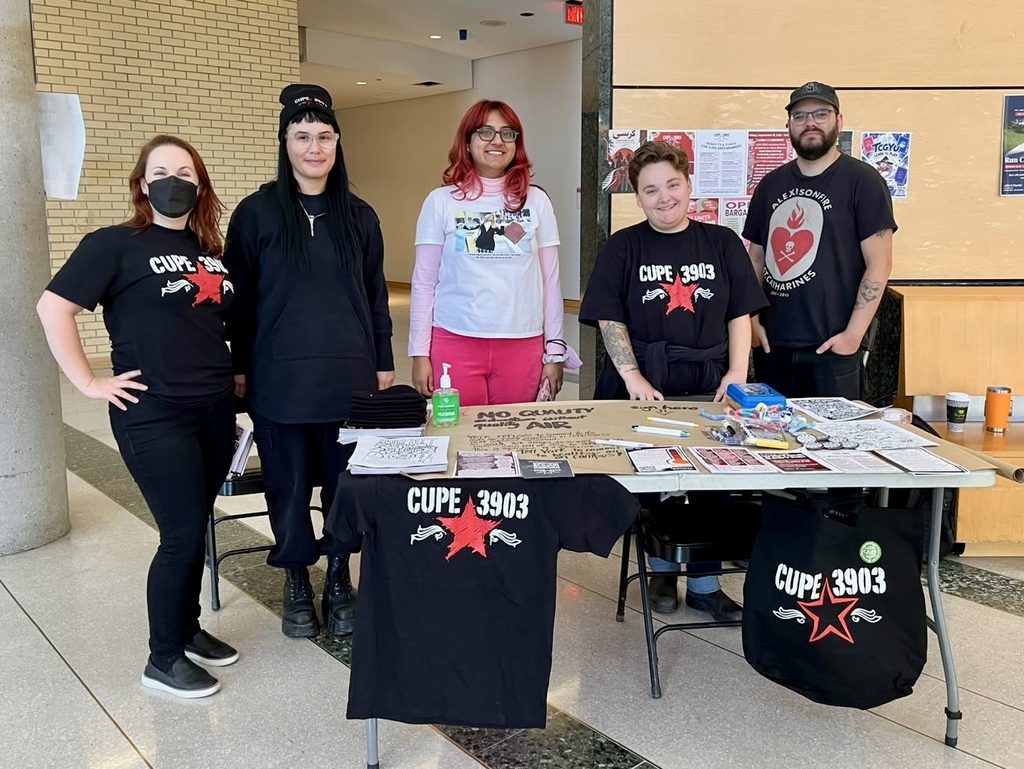
Your CUPE 3903 Units 1, 2, & 3 Bargaining Team (BT) kicked off the week with dynamic tabling sessions at both Vari Hall and Ross buildings, supported by members of the Executive Committee. In conversations while tabling, we connected with membership and students about what’s been happening at the bargaining table and two key Union proposals: air quality standards at York University (as part of our comprehensive Health and Safety proposal) and protections against artificial intelligence (which we’ll detail more in our next BT report).
In 2025, York worsened allowable air quality thresholds for carbon dioxide in its buildings, raising the previous limit of 1000 ppm to allow up to 5000 ppm, a rate that experts say can be “harmful to humans”. It is the absolute legal limit found in industrial settings, a limit that’s not even recommended in chicken coops.
CUPE 3903 has introduced Health and Safety proposals in this round of bargaining that would ensure appropriate air quality testing and ventilation to all buildings that meet Health Canada and ASHRAE (the American Society of Heating, Refrigerating and Air-Conditioning Engineers) standards. The Employer has so far refused those aspects of our proposals.
After filing for conciliation at the end of September, the BT has learned that Matthew Hamilton will be the assigned conciliator from the Ministry of Labour who will work with the Union and the Employer to try to bring both sides closer together. As it stands, the Union and Employer remain far apart on many key issues such as grievance procedure, artifical intelligence, Health and Safety, job stability programs (LSTAs), and evaluations to name just a few.
The Employer has also continued not responding to any of the Union’s proposals on wages, benefits, or funds, claiming that these monetary items will “go quickly at the end” in a “global package”. Unless the Employer plans to accept the Union’s proposals on these items outright (which the Employer has indicated they will not be doing), these pivotal proposals deserve adequate time at the table. It’s an inequitable practice for the Employer to continue to avoid discussing these items and stall the bargaining process. In contrast, the CUPE 3903 BT provided a complete package of proposals to the Employer in July so that our proposals could be evaluated holistically. It’s unfortunate that the Employer won’t show the same level of respect for the process in return.
At the October 6 bargaining session, the Employer provided the BT with 4 proposals (3 Employer counters and 1 list of responses to Letters of Agreements currently in the Units 1, 2, & 3 Collective Agreements (CAs). All of these can be found at cupe3903.org/bargaining/proposals
The Employer also requested responses from the BT on 7 items, 2 of which the BT had already provided a clear response of “No” on. The BT gave verbal responses to the below requests and will be providing written counters to the Employer on items 1-3 and 5-6 as early as our next bargaining session on Tuesday, October 13, from 10AM – 1PM, online and in-person room 280N in York Lanes.
- Article 6 Grievance Procedure
- Article 10.01.1 & Appendix F – Ticketed Course Directorship Opportunities (Unit 1)
- Article 12.01.2 – CSSP (Unit 2)
- Article 12.14 & 12.15 – NRA Period (Unit 2)
- The Employer’s proposal for 12.14 would reduce response time for late appointments for members to as little as 2 days. An inequitable and unrealistic time frame which is a concession for our membership was an emphatic NO from your BT.
- Article 23 – Affirmative Action Pool (Unit 2)
- Article 24 – LSTAs (Unit 2)
- Article 13 Evaluations – Units 1 & 2
- The Employer’s proposal would remove members’ option to choose their own evaluator, thereby expanding managerial overreach when it comes to evaluations. Another concession for our members is another emphatic NO from your BT.
Additionally, the BT and Employer had a fulsome discussion regarding the Employer’s proposal to add an additional step 3 to the grievance process, which would constitute the university’s “institutional” response. In light of the Employer’s current practices of failing to provide substantial response at Step 1 or 2 (the current institutional step), and forcing most grievances into arbitration, we wonder: why would the Union support extending an already lengthy and expensive process?
At the table, the Union raised specific examples of past grievance procedures and the failure of the Employer to engage fully in the process. If the Employer truly does want to expedite the grievance process (a comment they’ve made several times at the table), perhaps that starts with an effective use of the steps already in place by the Employer’s Labour Relations team.
The BT invites all members and students who want to get more involved in the bargaining process to email outreach@cupe3903.org and get connected with ways to support!
In solidarity,
CUPE 3903 Bargaining Team (Units 1, 2, & 3)
bargaining@cupe3903.org
Click here to read previous BT reports, and check the calendar for upcoming bargaining-related happenings.